A Model of Leadership Education, Part 3: So What Should it Be?

This is part 3 of an 8-part article.

Read Part 1 Here

Read Part 2 Here

These ideas represent the highest level of the current debate, and while there are some good ideas here, nothing comes close to lasting solutions that will really make the difference.  So much for the current generation of deep thinking about modern education and the role of higher education in the Twenty-first Century.


If we go back one generation, to the point in time when the thinkers were actually educated in the classics before taking up their careers, we learn much more that is valuable to the quest for an ideal college system.


Mortimer Adler, the editor of the Great Books, suggests that fixing modern American education is attained by not teaching anything of practical, applicational value.  That is, education can be improvedby ignoring job training and doing what schools were meant to do in the first place: educate through the classics.

Ironically, the result of schools actually providing superb education is that graduates are more equipped to think, innovate and lead in the corporate and career world.

By emphasizing job training in the schools, we have chosen to graduate non-educated workers who must be trained on the job anyway and only rise to leadership through personal gifts and “networking” with”influential superiors.”

The training of leaders, the fundamental role of college, is ignored.


Jacques Barzun, leader of the great books program at Columbia a

generation ago, suggested 68 changes that are needed in the university system.  Here we have included twelve :


  • The faculty, which is the university, must convey at every turn what education is; therefore must reduce and disdain the opportunities for professional cant.
  • Be . . . choosy about new projects.
  • Focus on teaching over research.
  • The university must maintain its role as the “guardian of learning,” not sell off to the highest bidder.
  • Teach the 3Rs better and more often.
  • Put learning ahead of credentials, or better still, end credentials.
  • Get out of the housing business.
  • Recover academic independence from the government, corporations, and other funders.
  • Stop taking grant money for non-education purposes. “Education is a full-time task. University endowment or state subsidy is for education; it is a misuse of funds and talent to embark on other than educational efforts.”
  • Make it clear to society that education is public service.
  • Create “cluster colleges”: colleges which do their own thing, but work in proximity with others.
  • Focus on the university’s role as the keeper of learning, and drop everything else.
  • Stop doing everything else, and start educating!


Allan Bloom, bestselling author of The Closing of the American Mind, suggested as late as 1987 that the only hope was to re-emphasize the classics in all parts of the undergraduate curriculum.  This excellent suggestion, the true hope of the university, was widely discussed and hardly implemented.


Robert Hutchins, former President of the University of Chicago, wrote in 1936     in The Higher Learning in America that each university has four goals:

1) Liberal Education-to train citizens and leaders for the nation.

2) Academic Education-to train researchers and professors for the university.

3) Professional Training-to train students in specific work skills for the market.

4) Political Education-to train government and quasi-government workers   for the state.

According to Hutchins, every college impacts all four, but every college also chooses one master-to the detriment of the other three.  The history of America higher education, Hutchins says, is numbers 1), 2)  and 3), and we are rapidly moving toward 4).  He labels the history of American education as Education for Liberty from 1780-1860, Education for Learning from 1860-1940, Education for the Market from 1940-2010(?), and Education for Government Bureaucracy as the legacy of the Twenty-firstCentury.


His solution to this trend was that in every generation, regardless of the outside trends, a few schools must choose 1): Education for Liberty.  If this happens, we will retain our freedoms.  If not, we will lose them. He was right.


And finally, Josiah Bunting of the Virginia Military Institute wrote in An Education for Our Time that old schools will not make the necessary changes to train citizens and statesmen for liberty and so the founding of new colleges is necessary.  This excellent book outlines how an ideal college, focused on  the classics and training leaders, can significantly impact the future of a nation and the world.  He was also right.


To Be Continued….
2 Responses

Krislyn Elliott & Lauren Swanepoel

Krislyn Elliott and Lauren Swanepoel act more like sisters than moms as they take really slow walks through the woods together, looking at and taking pictures of every plant they see & wishing they could remember their names and uses more thoroughly. They also like concocting herbal teas, salves, tinctures and strange drinks.

Krislyn is from Utah and has loved learning about plants since an unusually cool high school biology teacher took his classes on neighborhood botany walks. She has always been fascinated and constantly amazed at the power and beauty of plants.

Lauren is from South Africa, she and her family emigrated to Utah almost 10 years ago. They have fallen in love with the area and know more about this state & the great places to explore here than most Utah natives.

We both feel strongly about taking care of our families with natural methods and the abundant medicine we have growing right around us. We are trying to learn as much as we can about our magical local plants and are looking forward to sharing some of our favorites with you.

William DeMille

Director of Georgic Develeopment

William DeMille is a lifelong vegetable farmer. He studied Horticulture and Agronomy at Northwest Missouri University, Maryville. He holds a certificate in aquaponic engineering and production from Cornell University, NY, and another from GrowHaus Aquaponics in Denver, CO. He also studied soil regeneration and is a graduate of Dr. Elaine’s Soil Food Web School. He is the Director of Georgic Development for The Center for American Legacy Studies.

William is a farm consultant establishing several agricultural startups since 2005 in Missouri, Oregon, Colorado, Utah, and Nevada and he currently manages 2500 acres of grassland for the Ruby Mountain Foods Company.

His latest venture is a market gardening school called Georgic Revolution where he teaches a 17-week course onsite in Nevada covering soil health and vegetable production without the use of fertilizers, pesticides, herbicides, etc. and where he operated a soil lab.

William lives with his wife Vernie in the snow capped mountains of Northern Nevada.

Lloyd Nelson

World Renown BD Expert

Lloyd Nelson has been practicing the art of Biodynamic (BD) Agriculture for over twenty years. He is a BD preparation maker, builder, artist, farmer, arborist, BD educator & consultant. He is co-founder of Biodynamic Source – a Colorado based non-profit specializing in high potency BD preparations – and he owns and operates a Biodynamic spray, fertilizer and consultation service. He has worked with small and large scale farms, vineyards, and orchards to transition to sustainable Biodynamic land management and Demeter BD Certification.

Vern Cox, PhD

Educator

Vern Cox is married to Joyce Christensen and they have 8 children. He has 3 earned degrees, a BA in psychology, and both a Master’s degree and a Ph.D. in marriage and family therapy.

He has had a diverse and interesting career that started with the Bureau of Land Management, followed by a stint as a Learning Disabilities teacher, and finally a marriage and family therapist, working his way up to executive director of the High Country Counseling and Resource Centers that served two counties in Wyoming.

Dr. Cox served for several years on the board of a charter school. Dr. Cox remains heavily involved in his community and the home schooling movement.

He has extensive background in marriage and family counseling, having held a number of administrative positions during his first career. He holds a BA in Psychology and both a Masters and PhD in Marriage and Family Therapy. He lives with his wife and several married children on their multi-generation farm in Southern Utah.

Joseph Lofthouse

Educator

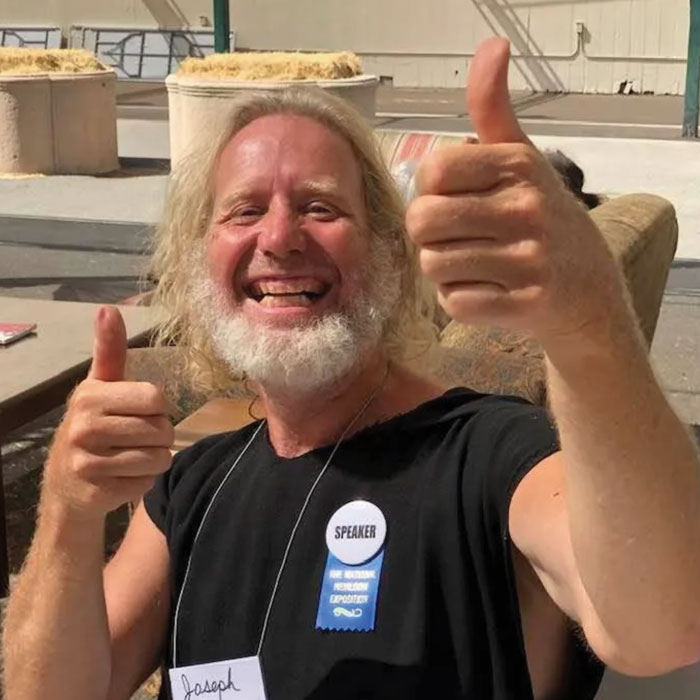
Joseph adopted the principles of landrace gardening in response to the harsh growing conditions in a high-altitude, short-season, desert garden. Instead of relying on expensive poisons, labor, and materials to coddle the plants, he encourages genetic diversity, cross-pollination, and survival of the fittest, allowing the plants to adapt themselves to the current and ever-changing ecosystem, thus simplifying gardening and seed saving. Joseph is the author of Landrace Gardening: Food Security Through Biodiversity and Promiscuous Pollination. Joseph loves eating, farming, swimming, hot-springs, sunbathing, bird-watching, running, yoga, leggings, kilts, playing guitar, singing, and living habitually barefoot.

Dan Brooks

Educator

Dan Brooks was born and raised in the Pacific Northwest. During his first career, he spent 20 years working in and managing high-end restaurants and golf courses including extensive banquet/special events services and ice sculptures.

For the past 23 years, Dan has been a successful entrepreneur and family business owner in Las Vegas. He and his wife have 4 children and 11 grandchildren. He serves as a trustee for The Center for American Legacy Studies.

Shanon Brooks, PhD

Director

Shanon Brooks is the director of The Center for American Legacy Studies, an institution dedicated to helping families embrace and incorporate the Five American Ideals; Georgics, Liber, Providence, Public Virtue, and Liberty into their lives and communities. America exists because of Americans. Americans are the beneficiaries of a peculiar culture and way of living.

Over the past 75 years, that culture and way of life have been lost. Restore that culture and Americans will rebuild America to once again be worthy of John Winthrop’s 1630 admonition, “For we must consider that we shall be as a city upon a hill. The eyes of all people are upon us.”

Brooks has been a leader in alternative higher education for over 30 years, and is the author of two books: AMERICAN: Killing the American Dream and A Thomas Jefferson Education for Teens.

Dr. Brooks is a veteran of military service in the United States Submarine Fleet and holds a Bachelor’s degree in business administration, a Master’s degree in education, and a Ph.D. in constitutional law.

He and his wife Julia reside on the 80-acre conference facility of The Center for American Legacy Studies.