Funding Monticello College: A 21st Century Approach

Historically, most American institutions of higher education struggled to fund themselves. Non-profit institutions did not generally have mechanisms for generating revenue. Thus they relied on tuition, donations, and an endowment.

downloadHarvard, America’s first school, suffered this same fate. In 1636, without any endowment (the gift from John Harvard, the school’s name sake was quickly squandered) the college opened it doors but due to lack of finances, it wasn’t long before they closed those doors, reopening later and repeating the process several times in its early history.

increase_matherIn 1642 Harvard’s president, thirty year-old Henry Dunster, went on a fund raising tour and secured enough “in-kind” subscriptions  called “colledge corne,” from local county residents to stabilize the finances.

But those subscriptions petered out in less than a decade.

Citizen subscriptions, sparce local taxes, donations, tuition, and endowments are how higher education was funded from 1636 until the early 1900’s.

By the end of WWII, the G.I. Bill became the popular means of funding higher education.

In 1965, the Johnson administration implemented the HEA (Higher Education Act), which served to help the poor and significantly increased the college population, but it also started the trend that we all now face– sky-rocketing tuition rates. By 1972 Pell Grants and ever popular student loans were added to the funding options provided to low and middle income students.

Since federal funded tuition was swelling the ranks of higher education, the government determined that it now had to regulate that which it was funding.

Accreditation morphed from a system of academic equivalence to the gate keeper of all higher academia, whether your students were receiving federal funds or not. (See the Monticello College white paper to determine if all of this money has improved the quality of higher education today.)

At Monticello College, we take a firm stand in not accepting a single dollar of federal money. We neither desire federal assistance nor do we ask for its oversight. But after 5 decades of Americans on the educational dole, the average family does not have the funds to pay for tuition out of pocket. We have lost the concept of pay-our-own-way.

As a result, Monticello College must find creative ways to fund our operations and build our endowment.

Enter Strongbrook.maxresdefault

Strongbrook is a real estate investment company with a unique 21st century approach to building client investment portfolio’s.

Probably the best explanation I have every heard comes from a 22-year-old college student video.

In an effort to funding the school, Monticello College has entered into a loose association with Strongbrook introducing the benefits offered by this exceptional company to our friends and supporters.

Not only can Strongbrook assist families in securing a strong and vibrant economic future, it helps to create the means to provide funds for student tuition.  Monticello College is also investing into a Strongbrook financial Game Plan with the intention of securing enough investment property to fully fund our endowment.

Click Here to watch a short video to learn more.

Click Here for a Free PDF book or audio book. (Passcode is….FREE)

Since launching in 2007, Strongbrook has helped more than 2,500 investors across 47 states invest profitably in real estate — during the worst recession we’ll see in our lifetimes.

In fact, their investors averaged a 19.8 percent return last year, despite the continued recession.

Meet real Strongbrook investors and hear their stories by watching this video:

P.S. I appreciate that this funding approach may seem unusual or even uncomfortable to some of you. All change is uncomfortable. And higher education is changing before our very eyes. Technology is having as much impact on higher education as it has had on everything else.

In a Fourth Turning world nothing remains the same.

Give us a fair chance to show you some things you may not know. Take the time to watch the videos or read the MC white paper or free books offered or click here to get an awesome education in financial freedom called Financial Freedom 2.0. At the very least, you will learn some things you didn’t know. In the best case scenario, this could change your entire financial future.

Krislyn Elliott & Lauren Swanepoel

Krislyn Elliott and Lauren Swanepoel act more like sisters than moms as they take really slow walks through the woods together, looking at and taking pictures of every plant they see & wishing they could remember their names and uses more thoroughly. They also like concocting herbal teas, salves, tinctures and strange drinks.

Krislyn is from Utah and has loved learning about plants since an unusually cool high school biology teacher took his classes on neighborhood botany walks. She has always been fascinated and constantly amazed at the power and beauty of plants.

Lauren is from South Africa, she and her family emigrated to Utah almost 10 years ago. They have fallen in love with the area and know more about this state & the great places to explore here than most Utah natives.

We both feel strongly about taking care of our families with natural methods and the abundant medicine we have growing right around us. We are trying to learn as much as we can about our magical local plants and are looking forward to sharing some of our favorites with you.

William DeMille

Director of Georgic Develeopment

William DeMille is a lifelong vegetable farmer. He studied Horticulture and Agronomy at Northwest Missouri University, Maryville. He holds a certificate in aquaponic engineering and production from Cornell University, NY, and another from GrowHaus Aquaponics in Denver, CO. He also studied soil regeneration and is a graduate of Dr. Elaine’s Soil Food Web School. He is the Director of Georgic Development for The Center for American Legacy Studies.

William is a farm consultant establishing several agricultural startups since 2005 in Missouri, Oregon, Colorado, Utah, and Nevada and he currently manages 2500 acres of grassland for the Ruby Mountain Foods Company.

His latest venture is a market gardening school called Georgic Revolution where he teaches a 17-week course onsite in Nevada covering soil health and vegetable production without the use of fertilizers, pesticides, herbicides, etc. and where he operated a soil lab.

William lives with his wife Vernie in the snow capped mountains of Northern Nevada.

Lloyd Nelson

World Renown BD Expert

Lloyd Nelson has been practicing the art of Biodynamic (BD) Agriculture for over twenty years. He is a BD preparation maker, builder, artist, farmer, arborist, BD educator & consultant. He is co-founder of Biodynamic Source – a Colorado based non-profit specializing in high potency BD preparations – and he owns and operates a Biodynamic spray, fertilizer and consultation service. He has worked with small and large scale farms, vineyards, and orchards to transition to sustainable Biodynamic land management and Demeter BD Certification.

Vern Cox, PhD

Educator

Vern Cox is married to Joyce Christensen and they have 8 children. He has 3 earned degrees, a BA in psychology, and both a Master’s degree and a Ph.D. in marriage and family therapy.

He has had a diverse and interesting career that started with the Bureau of Land Management, followed by a stint as a Learning Disabilities teacher, and finally a marriage and family therapist, working his way up to executive director of the High Country Counseling and Resource Centers that served two counties in Wyoming.

Dr. Cox served for several years on the board of a charter school. Dr. Cox remains heavily involved in his community and the home schooling movement.

He has extensive background in marriage and family counseling, having held a number of administrative positions during his first career. He holds a BA in Psychology and both a Masters and PhD in Marriage and Family Therapy. He lives with his wife and several married children on their multi-generation farm in Southern Utah.

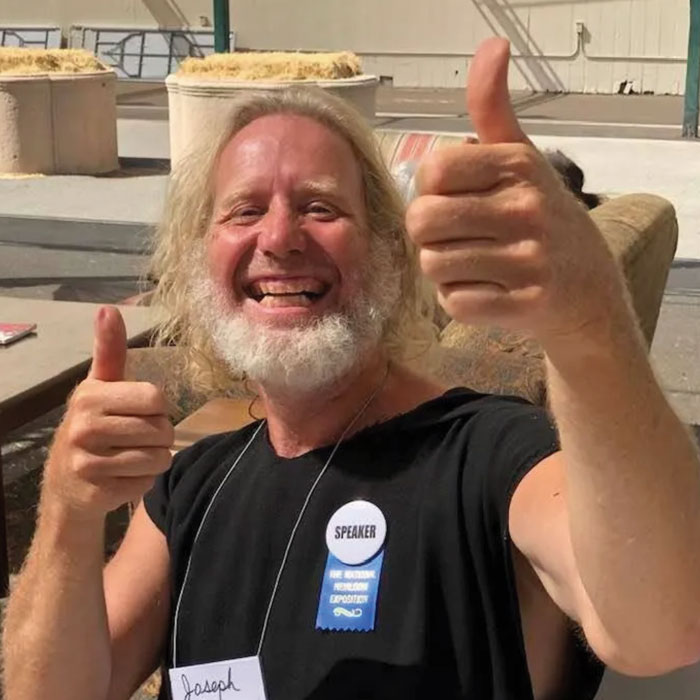
Joseph Lofthouse

Educator

Joseph adopted the principles of landrace gardening in response to the harsh growing conditions in a high-altitude, short-season, desert garden. Instead of relying on expensive poisons, labor, and materials to coddle the plants, he encourages genetic diversity, cross-pollination, and survival of the fittest, allowing the plants to adapt themselves to the current and ever-changing ecosystem, thus simplifying gardening and seed saving. Joseph is the author of Landrace Gardening: Food Security Through Biodiversity and Promiscuous Pollination. Joseph loves eating, farming, swimming, hot-springs, sunbathing, bird-watching, running, yoga, leggings, kilts, playing guitar, singing, and living habitually barefoot.

Dan Brooks

Educator

Dan Brooks was born and raised in the Pacific Northwest. During his first career, he spent 20 years working in and managing high-end restaurants and golf courses including extensive banquet/special events services and ice sculptures.

For the past 23 years, Dan has been a successful entrepreneur and family business owner in Las Vegas. He and his wife have 4 children and 11 grandchildren. He serves as a trustee for The Center for American Legacy Studies.

Shanon Brooks, PhD

Director

Shanon Brooks is the director of The Center for American Legacy Studies, an institution dedicated to helping families embrace and incorporate the Five American Ideals; Georgics, Liber, Providence, Public Virtue, and Liberty into their lives and communities. America exists because of Americans. Americans are the beneficiaries of a peculiar culture and way of living.

Over the past 75 years, that culture and way of life have been lost. Restore that culture and Americans will rebuild America to once again be worthy of John Winthrop’s 1630 admonition, “For we must consider that we shall be as a city upon a hill. The eyes of all people are upon us.”

Brooks has been a leader in alternative higher education for over 30 years, and is the author of two books: AMERICAN: Killing the American Dream and A Thomas Jefferson Education for Teens.

Dr. Brooks is a veteran of military service in the United States Submarine Fleet and holds a Bachelor’s degree in business administration, a Master’s degree in education, and a Ph.D. in constitutional law.

He and his wife Julia reside on the 80-acre conference facility of The Center for American Legacy Studies.