Reforming Education Out of Existence

WSJA March 9, 2013 Wall Street Journal article entitled “Doing a Texas Two-Step Around Educational Reform” once again brings to the forefront the fundamental discussion of “what is education and why?”

The article begins by summarizing the recent decision of over 800 Texas School Boards to lower high school graduation requirements.

Mr. Charles Cook, a co-author of this piece, makes the simple claim that decreased graduation requirements lead to decreased learning expectations, which lead to ignorance of the world we live in and failure as a nation:

Ever-lower expectations lead to one predictable outcome: a profound ignorance of the world among young people in an era when international events and evolving fiscal and trade policies have a personal impact on communities, businesses, and individuals in every corner of the U.S.

Citing the 2008 report “Still At Risk: What Students Don’t Know, Even Now,” Cook points out that its not just jobs that we should be concerned about but the greater concept of citizenship:

Allowing young people to graduate as historical or geographical illiterates is myopic for another reason.  Training them for getting jobs is not good enough; graduates of public schools are also citizens. Ask any physician today whether politics impacts his livelihood.

RSECook, the CEO of Responsive Ed, which operates sixty charter schools in Texas, then goes on to give an overview of the education for citizenship:

We have a different approach to equipping students to face the future, one that has the weight of millennia of human experience behind it: a rigorous classical education. Such an education (called liberal-arts at the college level) does not shortchange math and science. On the contrary, those subjects are studied with more rigor than can be seen in today’s public schools.           


Students also learn the fundamentals of English grammar; American and World history through the reading of primary documents; and the great stories of human struggle and yearning told by the greatest storytellers Homer, Shakespeare, Milton, and Melville.


They study the principles of liberty and self-government as articulated by the Founding Fathers and the ennobling beauties found in painting, sculpture, and song. Yes the children have to learn Latin, too, just as the Founding Fathers did, because that language gives the greatest insight into the vocabulary and grammar of our own tongue and the Romance languages, including Spanish.

Cook, then articulates what is on the mind of most every employer and what every employee entering the workforce should pay close attention to:

Certainly America needs as many engineers and computer scientists as the country requires in the 21st century.  But that does not describe what lies ahead for the vast majority of young people entering the marketplace. 


The most common complaints of American employers are that job applicants and recent hires lack communication skills and higher-level thinking skills. More plainly, many applicants cannot read a memo, they cannot express themselves in speech or in writing, they lack the ability to think through difficult problems.


imagesWe think that students who have been taught to write forcefully by studying Shakespeare and Tom Paine, who have learned to speak by studying the speeches of Cicero and Abraham Lincoln, who have learned to think through difficult problems by studying the Constitution through an analysis of the Federalist Papers, and who revel in the rigors of Latin grammar will have no difficulty in reading the boss’s memo.


Training Young people in the liberal arts and science also will better prepare them to become the “boss” when it is time for the present cohort of bosses to retire. Those on the front lines of hiring employees in this state see the need for a classical education.

Cook ends the article with this pointed paragraph:


Jobs do not create the human mind; the human mind creates jobs.  As a result, the very best education—the kind the Founding Fathers had—is what will produce good workers and good citizens.  The challenge for those who want to eliminate testing in world history and geography or the other subjects in Texas is to explain how students are prepared for a global economy when they are not required to learn anything about either the globe or the economy.

Thanks to my friend Pam O’Dell of New York who continues to scour the WSJ for pertinent articles.

Krislyn Elliott & Lauren Swanepoel

Krislyn Elliott and Lauren Swanepoel act more like sisters than moms as they take really slow walks through the woods together, looking at and taking pictures of every plant they see & wishing they could remember their names and uses more thoroughly. They also like concocting herbal teas, salves, tinctures and strange drinks.

Krislyn is from Utah and has loved learning about plants since an unusually cool high school biology teacher took his classes on neighborhood botany walks. She has always been fascinated and constantly amazed at the power and beauty of plants.

Lauren is from South Africa, she and her family emigrated to Utah almost 10 years ago. They have fallen in love with the area and know more about this state & the great places to explore here than most Utah natives.

We both feel strongly about taking care of our families with natural methods and the abundant medicine we have growing right around us. We are trying to learn as much as we can about our magical local plants and are looking forward to sharing some of our favorites with you.

William DeMille

Director of Georgic Develeopment

William DeMille is a lifelong vegetable farmer. He studied Horticulture and Agronomy at Northwest Missouri University, Maryville. He holds a certificate in aquaponic engineering and production from Cornell University, NY, and another from GrowHaus Aquaponics in Denver, CO. He also studied soil regeneration and is a graduate of Dr. Elaine’s Soil Food Web School. He is the Director of Georgic Development for The Center for American Legacy Studies.

William is a farm consultant establishing several agricultural startups since 2005 in Missouri, Oregon, Colorado, Utah, and Nevada and he currently manages 2500 acres of grassland for the Ruby Mountain Foods Company.

His latest venture is a market gardening school called Georgic Revolution where he teaches a 17-week course onsite in Nevada covering soil health and vegetable production without the use of fertilizers, pesticides, herbicides, etc. and where he operated a soil lab.

William lives with his wife Vernie in the snow capped mountains of Northern Nevada.

Lloyd Nelson

World Renown BD Expert

Lloyd Nelson has been practicing the art of Biodynamic (BD) Agriculture for over twenty years. He is a BD preparation maker, builder, artist, farmer, arborist, BD educator & consultant. He is co-founder of Biodynamic Source – a Colorado based non-profit specializing in high potency BD preparations – and he owns and operates a Biodynamic spray, fertilizer and consultation service. He has worked with small and large scale farms, vineyards, and orchards to transition to sustainable Biodynamic land management and Demeter BD Certification.

Vern Cox, PhD

Educator

Vern Cox is married to Joyce Christensen and they have 8 children. He has 3 earned degrees, a BA in psychology, and both a Master’s degree and a Ph.D. in marriage and family therapy.

He has had a diverse and interesting career that started with the Bureau of Land Management, followed by a stint as a Learning Disabilities teacher, and finally a marriage and family therapist, working his way up to executive director of the High Country Counseling and Resource Centers that served two counties in Wyoming.

Dr. Cox served for several years on the board of a charter school. Dr. Cox remains heavily involved in his community and the home schooling movement.

He has extensive background in marriage and family counseling, having held a number of administrative positions during his first career. He holds a BA in Psychology and both a Masters and PhD in Marriage and Family Therapy. He lives with his wife and several married children on their multi-generation farm in Southern Utah.

Joseph Lofthouse

Educator

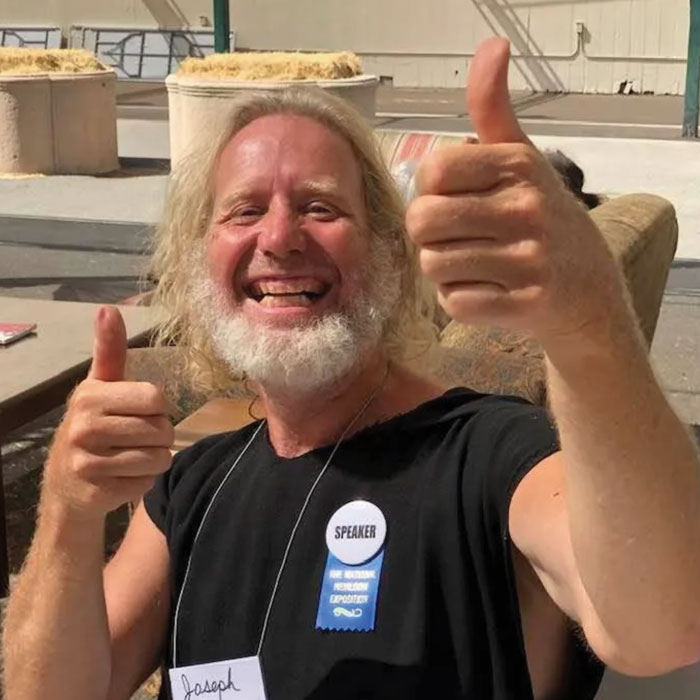
Joseph adopted the principles of landrace gardening in response to the harsh growing conditions in a high-altitude, short-season, desert garden. Instead of relying on expensive poisons, labor, and materials to coddle the plants, he encourages genetic diversity, cross-pollination, and survival of the fittest, allowing the plants to adapt themselves to the current and ever-changing ecosystem, thus simplifying gardening and seed saving. Joseph is the author of Landrace Gardening: Food Security Through Biodiversity and Promiscuous Pollination. Joseph loves eating, farming, swimming, hot-springs, sunbathing, bird-watching, running, yoga, leggings, kilts, playing guitar, singing, and living habitually barefoot.

Dan Brooks

Educator

Dan Brooks was born and raised in the Pacific Northwest. During his first career, he spent 20 years working in and managing high-end restaurants and golf courses including extensive banquet/special events services and ice sculptures.

For the past 23 years, Dan has been a successful entrepreneur and family business owner in Las Vegas. He and his wife have 4 children and 11 grandchildren. He serves as a trustee for The Center for American Legacy Studies.

Shanon Brooks, PhD

Director

Shanon Brooks is the director of The Center for American Legacy Studies, an institution dedicated to helping families embrace and incorporate the Five American Ideals; Georgics, Liber, Providence, Public Virtue, and Liberty into their lives and communities. America exists because of Americans. Americans are the beneficiaries of a peculiar culture and way of living.

Over the past 75 years, that culture and way of life have been lost. Restore that culture and Americans will rebuild America to once again be worthy of John Winthrop’s 1630 admonition, “For we must consider that we shall be as a city upon a hill. The eyes of all people are upon us.”

Brooks has been a leader in alternative higher education for over 30 years, and is the author of two books: AMERICAN: Killing the American Dream and A Thomas Jefferson Education for Teens.

Dr. Brooks is a veteran of military service in the United States Submarine Fleet and holds a Bachelor’s degree in business administration, a Master’s degree in education, and a Ph.D. in constitutional law.

He and his wife Julia reside on the 80-acre conference facility of The Center for American Legacy Studies.