Let Us Dare: Writings From John Adams

In late 1765, John Adams began writing an essay entitled, “A Dissertation on the Canon and Feudal Law.” He was 30 years old and just beginning to stretch his legal and political wings.

His purpose for writing this essay was to contrast the tyranny of feudal and canon law with the glorious struggle for freedom in the not-too-distant past of England and the coming efforts in America.

You will recall that this was right around the time of the infamous Stamp Act. He recorded his thoughts at the time, depicting the Stamp Act, as an “enormous Engine, fabricated by the British Parliament, for battering down all the Rights and Liberties of America.”

What follows is an instructive excerpt from this powerful and expressive treatise of the oppressive tendencies of big government and instruction on how the citizenry should respond. It is highly applicable to our time.

“Let us banish forever from our minds, my countrymen, all such unworthy ideas of the king, his ministry and parliament. Let us not suppose that all are become luxurious, effeminate, and unreasonable, on the other side the water, as many designing persons would insinuate.”

“Let us presume, what is in fact true, that the spirit of liberty is as ardent as ever among the body of the nation, though a few individuals may be corrupted.”

“Let us take it for granted, that the same great spirit which once gave Caesar so warm a reception, which denounced hostilities against John till Magna Charta was signed, which severed the head Charles the First from his body, and drove James the Second from his kingdom, the same great spirit (may heaven preserve it till the earth shall be no more) which first seated the great-grandfather of his present most gracious majesty on the throne of Britain, — is still alive and active and warm in England; and that the same spirit in America, instead of provoking the inhabitants of that country, will endear us to them for ever, and secure their good-will.”

“This spirit, however, without knowledge, would be little better than a brutal rage. Let us tenderly and kindly cherish, therefore, the means of knowledge.”

“Let us dare to read, think, speak, and write. Let every order and degree among the people rouse their attention and animate their resolution.

“Let them all become attentive to the grounds and principles of government, ecclesiastical and civil.”

“Let us study the law of nature; search into the spirit the British constitution; read the histories of ancient ages; contemplate the great examples of Greece and Rome; set before us the conduct of our own British ancestors, who have defended for us the inherent rights of mankind against foreign and domestic tyrants and usurpers, against arbitrary kings and cruel priests, in short, against the gates of earth and hell.”

“Let us read and recollect and impress upon our souls the views and ends of our own more immediate forefathers, in exchanging their native country for a dreary, inhospitable wildness.”

“Let us examine into the nature of that power, and the cruelty of that oppression, which drove them from their homes.”

“Recollect their amazing fortitude, their bitter sufferings, — the hunger, the nakedness, the cold, which they patiently endured, — the severe labors of clearing their grounds, building their houses, raising their provisions, and amidst dangers from wild beast and savage men, before they had time or money or materials for commerce.”

“Recollect the civil and religious principles and hopes and expectations which constantly supported and carried them through all hardships with patience and resignation.”

“Let us recollect it was liberty, the hope of liberty for themselves and us and ours, which conquered all discouragements, dangers, and trials. In such researches as these, let us all in our several departments cheerfully engage, — but especially the proper patrons and supporters of law, learning, and religion!”

“Let the pulpit resound with the doctrines and sentiments of religious liberty. Let us hear the danger of thraldom [bondage] to our consciences from ignorance, extreme poverty, and dependence, in short, from civil and political slavery.”

Additional reading: Revolutionary Writings of John Adams, www.libertyfund.org.

2 Responses

    1. I just love this part:

      This spirit, however, without knowledge, would be little better than a brutal rage. Let us tenderly and kindly cherish, therefore, the means of knowledge.”
      “Let us dare to read, think, speak, and write. Let every order and degree among the people rouse their attention and animate their resolution.
      “Let them all become attentive to the grounds and principles of government, ecclesiastical and civil.”
      “Let us study the law of nature; search into the spirit the British constitution; read the histories of ancient ages; contemplate the great examples of Greece and Rome; set before us the conduct of our own British ancestors, who have defended for us the inherent rights of mankind against foreign and domestic tyrants and usurpers, against arbitrary kings and cruel priests, in short, against the gates of earth and hell.”

      I so want to figure out how to turn this into a drink and give away to every American. But there are 100 citizens in New York who are getting a taste the old fashion way, I say these are the hope of New York.

Krislyn Elliott & Lauren Swanepoel

Krislyn Elliott and Lauren Swanepoel act more like sisters than moms as they take really slow walks through the woods together, looking at and taking pictures of every plant they see & wishing they could remember their names and uses more thoroughly. They also like concocting herbal teas, salves, tinctures and strange drinks.

Krislyn is from Utah and has loved learning about plants since an unusually cool high school biology teacher took his classes on neighborhood botany walks. She has always been fascinated and constantly amazed at the power and beauty of plants.

Lauren is from South Africa, she and her family emigrated to Utah almost 10 years ago. They have fallen in love with the area and know more about this state & the great places to explore here than most Utah natives.

We both feel strongly about taking care of our families with natural methods and the abundant medicine we have growing right around us. We are trying to learn as much as we can about our magical local plants and are looking forward to sharing some of our favorites with you.

William DeMille

Director of Georgic Develeopment

William DeMille is a lifelong vegetable farmer. He studied Horticulture and Agronomy at Northwest Missouri University, Maryville. He holds a certificate in aquaponic engineering and production from Cornell University, NY, and another from GrowHaus Aquaponics in Denver, CO. He also studied soil regeneration and is a graduate of Dr. Elaine’s Soil Food Web School. He is the Director of Georgic Development for The Center for American Legacy Studies.

William is a farm consultant establishing several agricultural startups since 2005 in Missouri, Oregon, Colorado, Utah, and Nevada and he currently manages 2500 acres of grassland for the Ruby Mountain Foods Company.

His latest venture is a market gardening school called Georgic Revolution where he teaches a 17-week course onsite in Nevada covering soil health and vegetable production without the use of fertilizers, pesticides, herbicides, etc. and where he operated a soil lab.

William lives with his wife Vernie in the snow capped mountains of Northern Nevada.

Lloyd Nelson

World Renown BD Expert

Lloyd Nelson has been practicing the art of Biodynamic (BD) Agriculture for over twenty years. He is a BD preparation maker, builder, artist, farmer, arborist, BD educator & consultant. He is co-founder of Biodynamic Source – a Colorado based non-profit specializing in high potency BD preparations – and he owns and operates a Biodynamic spray, fertilizer and consultation service. He has worked with small and large scale farms, vineyards, and orchards to transition to sustainable Biodynamic land management and Demeter BD Certification.

Vern Cox, PhD

Educator

Vern Cox is married to Joyce Christensen and they have 8 children. He has 3 earned degrees, a BA in psychology, and both a Master’s degree and a Ph.D. in marriage and family therapy.

He has had a diverse and interesting career that started with the Bureau of Land Management, followed by a stint as a Learning Disabilities teacher, and finally a marriage and family therapist, working his way up to executive director of the High Country Counseling and Resource Centers that served two counties in Wyoming.

Dr. Cox served for several years on the board of a charter school. Dr. Cox remains heavily involved in his community and the home schooling movement.

He has extensive background in marriage and family counseling, having held a number of administrative positions during his first career. He holds a BA in Psychology and both a Masters and PhD in Marriage and Family Therapy. He lives with his wife and several married children on their multi-generation farm in Southern Utah.

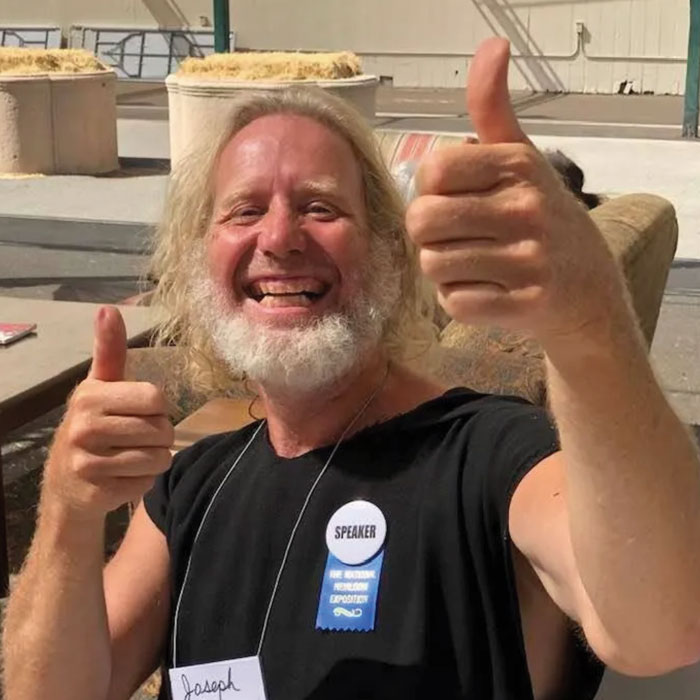
Joseph Lofthouse

Educator

Joseph adopted the principles of landrace gardening in response to the harsh growing conditions in a high-altitude, short-season, desert garden. Instead of relying on expensive poisons, labor, and materials to coddle the plants, he encourages genetic diversity, cross-pollination, and survival of the fittest, allowing the plants to adapt themselves to the current and ever-changing ecosystem, thus simplifying gardening and seed saving. Joseph is the author of Landrace Gardening: Food Security Through Biodiversity and Promiscuous Pollination. Joseph loves eating, farming, swimming, hot-springs, sunbathing, bird-watching, running, yoga, leggings, kilts, playing guitar, singing, and living habitually barefoot.

Dan Brooks

Educator

Dan Brooks was born and raised in the Pacific Northwest. During his first career, he spent 20 years working in and managing high-end restaurants and golf courses including extensive banquet/special events services and ice sculptures.

For the past 23 years, Dan has been a successful entrepreneur and family business owner in Las Vegas. He and his wife have 4 children and 11 grandchildren. He serves as a trustee for The Center for American Legacy Studies.

Shanon Brooks, PhD

Director

Shanon Brooks is the director of The Center for American Legacy Studies, an institution dedicated to helping families embrace and incorporate the Five American Ideals; Georgics, Liber, Providence, Public Virtue, and Liberty into their lives and communities. America exists because of Americans. Americans are the beneficiaries of a peculiar culture and way of living.

Over the past 75 years, that culture and way of life have been lost. Restore that culture and Americans will rebuild America to once again be worthy of John Winthrop’s 1630 admonition, “For we must consider that we shall be as a city upon a hill. The eyes of all people are upon us.”

Brooks has been a leader in alternative higher education for over 30 years, and is the author of two books: AMERICAN: Killing the American Dream and A Thomas Jefferson Education for Teens.

Dr. Brooks is a veteran of military service in the United States Submarine Fleet and holds a Bachelor’s degree in business administration, a Master’s degree in education, and a Ph.D. in constitutional law.

He and his wife Julia reside on the 80-acre conference facility of The Center for American Legacy Studies.