Success vs Failure

failureIn our current culture failure means: lack of success; an unsuccessful person, enterprise, or thing.

But that is a narrow and incomplete definition.

If you look further, you will find a more complete definition: a lack or deficiency of desired quality; the action or state of not functioning; a sudden cessation of power.

What this demonstrates is that failure is not something that happens to you, but something you choose.

Failure is really just us quitting.

Failure quotes (13)EPIPHANY!! As long as we never quit, we never fail.

Let me say it differently. There are two types of success; gestational success and actual success.

Actual success is defined as: the accomplishment of an aim or purpose, the outcome of an undertaking specified as achieving its aim.

So Success means that you have achieved 100% or more of your desired aim or outcome. Gestational Success simply means that you have not yet fully achieved your desired aim or outcome, but are on the path to doing so. Success is not instantaneous. There is a lag time or gestation period between desire, action, and outcome.

On our campus farm, we often have a goal to hatch out chicks. We take action to setup the incubator, wherein we place the fertilized eggs. Then when we return the next morning and there are no chicks—we have no choice, we must concede failure…right?

Of course, not! Because we understand that there is a gestation period, we know that it is a work in progress and that it will take 21 days for the process to complete. So if we are not failing during the 21-day process, what are we doing? We are participating in gestational success!! Even though we can’t see it, there is plenty happening inside the egg, or the seed in the ground, or the mind of the infant, etc.

WebFailure then is not something that can happen to us, it is not a phenomenon that is out of our control—it is a choice…pure and simple.

Gestational Success is continued effort until the completion or end of the gestational period.

When dealing with the hatching of chickens or the breeding of any farm animal, long experience has taught us what to expect or has informed our expectations, so we are resolved to maintain our vigilance for the duration of the perceived gestation period.

But what if we are creating something new and are not sure of the gestation period or all of the proper steps to take during the gestation process? This is where preparation is vital. Even though the process may be new to us, it is not new to everyone. Chances are, someone has already done all of the hard work to figure out the gestational period and process. All we have to do is find them and replicate what they have done—and never give up.

090912-chick-chicagoWhen we are hatching chicks, we don’t get creative and try to change the gestation period or process.

In a similar manner, we trust those who have gone before us in areas where we have little first hand knowledge.

Our expectations are created based on their “fruits”and we follow their example to the “T” anticipating the same results.

We have full confidence that what they have done–we can do. We clearly see that Gestational Success precedes Actual Success and we never concede to failure, because we never give up.

Not all of our eggs always hatch…so do we then consider our efforts a failure? Of course not, even if only 5 out of 10 eggs hatch (which almost never happens), we still have 5 chicks that will grow up to lay eggs from which we can try again. As long as we never quit, we never fail.

successThe dictionary and real life definition of failure is to enter a state of not functioning or a cessation of power.

Only death can force us to not function or to cease exerting power. Let’s be honest, any other situation where we enter a state of not functioning or a cessation of power is nothing more than us quitting.

Bottom Line: we are either quitters or we are doers, and it has nothing to do with anyone else.

Personalized:

Bottom Line: I am either a quitter or I am a doer, and it has nothing to do with anyone else.

DECIDE.   ACT.   SUCCEED.

2 Responses

  1. Yes! Spot on. Brene Brown, researcher of shame for 15? years and more recently of the trait resiliency started me 2.5 years ago on the path to this here truth you summarized, Dr. Brooks. She highlighted this quote in one of her books that your writing here reminds me of:

    “It is not the critic who counts; not the man who points out how the strong man stumbles, or where the doer of deeds could have done them better. The credit belongs to the man who is actually in the arena, whose face is marred by dust and sweat and blood; who strives valiantly; who errs, who comes short again and again, because there is no effort without error and shortcoming; but who does actually strive to do the deeds; who knows great enthusiasms, the great devotions; who spends himself in a worthy cause; who at the best knows in the end the triumph of high achievement, and who at the worst, if he fails, at least fails while daring greatly, so that his place shall never be with those cold and timid souls who neither know victory nor defeat.”
    – Theodore Roosevelt
    April 23, 1910
    known as “The Man in the Arena” quote from his speech “Citizenship in the Republic”delivered in Paris.

Krislyn Elliott & Lauren Swanepoel

Krislyn Elliott and Lauren Swanepoel act more like sisters than moms as they take really slow walks through the woods together, looking at and taking pictures of every plant they see & wishing they could remember their names and uses more thoroughly. They also like concocting herbal teas, salves, tinctures and strange drinks.

Krislyn is from Utah and has loved learning about plants since an unusually cool high school biology teacher took his classes on neighborhood botany walks. She has always been fascinated and constantly amazed at the power and beauty of plants.

Lauren is from South Africa, she and her family emigrated to Utah almost 10 years ago. They have fallen in love with the area and know more about this state & the great places to explore here than most Utah natives.

We both feel strongly about taking care of our families with natural methods and the abundant medicine we have growing right around us. We are trying to learn as much as we can about our magical local plants and are looking forward to sharing some of our favorites with you.

William DeMille

Director of Georgic Develeopment

William DeMille is a lifelong vegetable farmer. He studied Horticulture and Agronomy at Northwest Missouri University, Maryville. He holds a certificate in aquaponic engineering and production from Cornell University, NY, and another from GrowHaus Aquaponics in Denver, CO. He also studied soil regeneration and is a graduate of Dr. Elaine’s Soil Food Web School. He is the Director of Georgic Development for The Center for American Legacy Studies.

William is a farm consultant establishing several agricultural startups since 2005 in Missouri, Oregon, Colorado, Utah, and Nevada and he currently manages 2500 acres of grassland for the Ruby Mountain Foods Company.

His latest venture is a market gardening school called Georgic Revolution where he teaches a 17-week course onsite in Nevada covering soil health and vegetable production without the use of fertilizers, pesticides, herbicides, etc. and where he operated a soil lab.

William lives with his wife Vernie in the snow capped mountains of Northern Nevada.

Lloyd Nelson

World Renown BD Expert

Lloyd Nelson has been practicing the art of Biodynamic (BD) Agriculture for over twenty years. He is a BD preparation maker, builder, artist, farmer, arborist, BD educator & consultant. He is co-founder of Biodynamic Source – a Colorado based non-profit specializing in high potency BD preparations – and he owns and operates a Biodynamic spray, fertilizer and consultation service. He has worked with small and large scale farms, vineyards, and orchards to transition to sustainable Biodynamic land management and Demeter BD Certification.

Vern Cox, PhD

Educator

Vern Cox is married to Joyce Christensen and they have 8 children. He has 3 earned degrees, a BA in psychology, and both a Master’s degree and a Ph.D. in marriage and family therapy.

He has had a diverse and interesting career that started with the Bureau of Land Management, followed by a stint as a Learning Disabilities teacher, and finally a marriage and family therapist, working his way up to executive director of the High Country Counseling and Resource Centers that served two counties in Wyoming.

Dr. Cox served for several years on the board of a charter school. Dr. Cox remains heavily involved in his community and the home schooling movement.

He has extensive background in marriage and family counseling, having held a number of administrative positions during his first career. He holds a BA in Psychology and both a Masters and PhD in Marriage and Family Therapy. He lives with his wife and several married children on their multi-generation farm in Southern Utah.

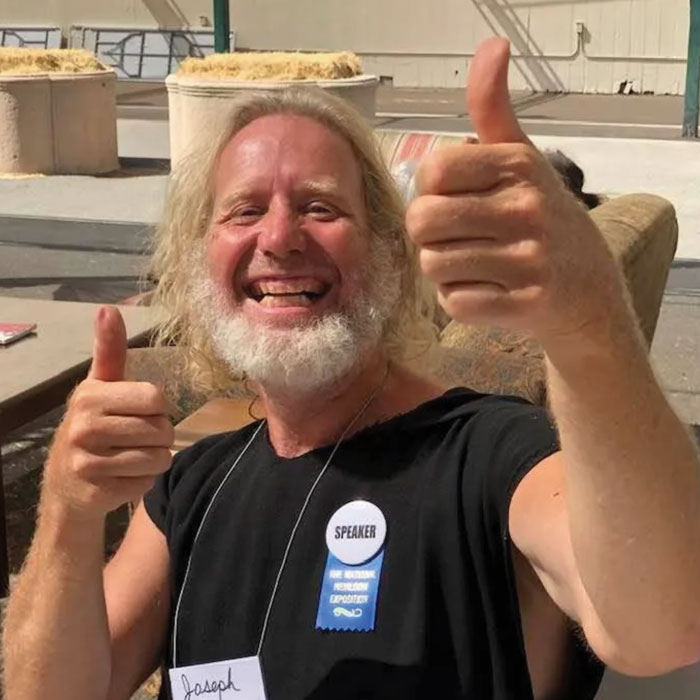
Joseph Lofthouse

Educator

Joseph adopted the principles of landrace gardening in response to the harsh growing conditions in a high-altitude, short-season, desert garden. Instead of relying on expensive poisons, labor, and materials to coddle the plants, he encourages genetic diversity, cross-pollination, and survival of the fittest, allowing the plants to adapt themselves to the current and ever-changing ecosystem, thus simplifying gardening and seed saving. Joseph is the author of Landrace Gardening: Food Security Through Biodiversity and Promiscuous Pollination. Joseph loves eating, farming, swimming, hot-springs, sunbathing, bird-watching, running, yoga, leggings, kilts, playing guitar, singing, and living habitually barefoot.

Dan Brooks

Educator

Dan Brooks was born and raised in the Pacific Northwest. During his first career, he spent 20 years working in and managing high-end restaurants and golf courses including extensive banquet/special events services and ice sculptures.

For the past 23 years, Dan has been a successful entrepreneur and family business owner in Las Vegas. He and his wife have 4 children and 11 grandchildren. He serves as a trustee for The Center for American Legacy Studies.

Shanon Brooks, PhD

Director

Shanon Brooks is the director of The Center for American Legacy Studies, an institution dedicated to helping families embrace and incorporate the Five American Ideals; Georgics, Liber, Providence, Public Virtue, and Liberty into their lives and communities. America exists because of Americans. Americans are the beneficiaries of a peculiar culture and way of living.

Over the past 75 years, that culture and way of life have been lost. Restore that culture and Americans will rebuild America to once again be worthy of John Winthrop’s 1630 admonition, “For we must consider that we shall be as a city upon a hill. The eyes of all people are upon us.”

Brooks has been a leader in alternative higher education for over 30 years, and is the author of two books: AMERICAN: Killing the American Dream and A Thomas Jefferson Education for Teens.

Dr. Brooks is a veteran of military service in the United States Submarine Fleet and holds a Bachelor’s degree in business administration, a Master’s degree in education, and a Ph.D. in constitutional law.

He and his wife Julia reside on the 80-acre conference facility of The Center for American Legacy Studies.